
Blog
Business Signage in Melbourne: Your Ultimate Shopfront Strategy Guide

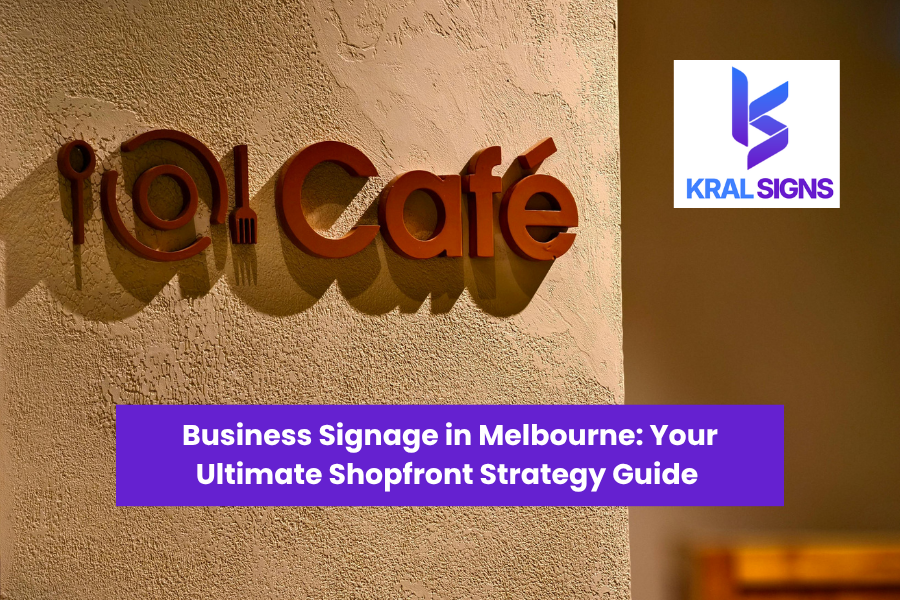
Melbourne is a very hard nut to crack. No matter whether you are establishing your store in the very trendy Collins Street or conducting an industrial giant in Dandenong, there is one thing that you are sure of and that is that unless people can see you, you do not exist. Thousands of locals give our famous laneways and suburban strips a whack every hour, and your shopfront is not only a place of business, but also your 24-hour silent salesman.
But here’s the rub. Melburnians are designed for conscious people. We are detailed oriented, and we are not too keen on cheap and cheerful. A good enough is not only a missed chance in 2026, but also a liability that can even send customers away. The only way to win in this is to have an effective signage strategy that not only appears premium but is also on-brand and able to survive our unpredictable weather.
In this guide, we’re stripping back the fluff to look at what actually works for business signage in Melbourne. We’ll cover everything from the psychology of design to the headache of local council permits. Whether you’re a brand-new startup in Brunswick or a franchise expanding through the South Eastern suburbs, this is your no-nonsense blueprint for getting noticed and staying ahead.
1. The Psychology of Sight: Why Melbourne Signage is Different
Melbourne is not Sydney and it is no Brisbane. We possess distinct urbanism, a blend of Victorian-era legacy, rough industrialism, and ultra-modern glass buildings.
Understanding the "Split-Second" Rule
Studies carried out in the field of environmental psychology propose that a driver will have a range of 1.5 to 3 seconds to attend an outdoor sign whereas a pedestrian would allow you 5 to 7 seconds. In a city such as Melbourne, where weather conditions can change to blinding sun to a grey overcast in a matter of minutes, your outdoor signage for small business has to be designed to be most legible under any weather conditions.
Key psychological triggers of effective signage:
- Familiarity: Consistent use of brand colours builds trust over time.
- Authority: High-quality materials (like 3D fabricated metals) suggest a stable, successful business.
- Call to Adventure: Effective retail signage solutions in Melbourne don't just say "we are here"; they invite the customer to experience something.
2. Types of Business Signage Melbourne Owners Must Master
To build a "Signage Ecosystem," you cannot rely on a single banner. You need layers. Let's look at the essential components of custom business signs in Melbourne.
A. 3D Fabricated & Illuminated Lettering
To be taken seriously in the Melbourne CBD or night-trading streets such as Chapel Street, 3D lights are mandatory (the letters themselves can be made of acrylic or stainless steel), and it is depth and shadow that cannot be achieved with flat signs.
- Backlit (Halo) Lighting: Perfect for high-end boutiques and professional services wanting a "prestige" look.
- Front-Lit: The gold standard for maximum "pop" and readability from a distance.
B. The Iconic Under-Awning (Blade) Sign
Melbourne’s shopping strips are defined by their footpaths. Because most shops have awnings to protect pedestrians from our "four seasons in one day," a fascia sign is often invisible to someone walking right past your door. The under-awning sign is your primary tool for capturing foot traffic. A well-designed blade sign acts as a "thumbstop" for the physical world.
C. Large Format Fascia Signs
This is your primary "ID." It sits above the door and tells the world who you are. Modern shop sign design in Melbourne often utilizes ACM (Aluminium Composite Material) panels because they remain perfectly flat, don't rust, and provide a premium finish that lasts for a decade or more.
D. Window Graphics and Privacy Frosting
Your windows are essentially free for advertising space.
- Full Wraps: For high-impact branding.
- One-Way Vision: You see out but have a beautiful graphic to passersby. Very nice in gym or office where privacy is required
- Computer-Cut Decals: The best bet to promote trading hours, social media profiles and core services.
3. The Technical Side: Materials and Durability
A common mistake many business owners make is choosing the cheapest quote without looking at the material specs. In Melbourne, the UV index in summer is brutal, and the wind loads in coastal areas like St Kilda or Brighton can rip poor-quality signs right off the wall.
The "Kral Signs" Standard for Materials:
- Acrylics: Our acrylic is high grade and UV-stabilised ensuring it will not be yellow or brittle in the sun.
- LEDs: Not all LEDs are equal. Our modules are IP67s and are energy-conserving and do not require replacement after using more than 50,000 hours.
- Vinyls: We recommend casting vinyls over monomeric vinyls for outdoor use. Why? Because they don't shrink or "tent" around rivets and curves.
- Specialised Coatings: Anti-graffiti films are a wise investment for businesses in high-traffic urban areas like Fitzroy or Footscray.
4. Navigating the "Red Tape": Permits and Regulations
The numerous local councils are one of the major headaches of commercial signage companies in Melbourne. Every LGA (Local Government Area) possesses its policies.
- Melbourne City Council: Quite strict regarding heritage buildings and the over-illumination.
- Yarra City Council: Focuses heavily on the aesthetic "fit" within the artistic community.
- Stonnington and Boroondara: There are usually setback and height requirements of pylons.
Pro Tip: Before you put your signature on a design, make sure that your signage partner is conversant with the Victorian Planning Provisions. A planning permit may be required when your sign is not only lit up, but it goes beyond a particular size or when it is located on a heritage overlay. We do not simply construct the sign. At Kral Signs we will guide you through these challenges, and you will not find yourself paying the fine to the council.
5. Designing for Impact: The "Less is More" Philosophy
In shop sign design in Melbourne, clutter is the enemy of conversion. When a business tries to put their logo, phone number, website, list of 20 services, and a "Special Offer" on one sign, the human brain simply switches off.
The Hierarchy of Information
Colour Theory in the Melbourne Context
- Charcoal & Black: Very popular in Melbourne for a sleek, "industrial-chic" look. Pairs beautifully with timber and greenery.
- High-Contrast Yellow/Black: Best for safety and industrial sectors where visibility is the only priority.
- Teals and Soft Greens: Gaining massive traction in the wellness and healthcare sectors across the eastern suburbs.
6. Digital Integration: Signage in the Phygital World
It’s 2026, your physical signs should talk to your digital presence. This is one of the fundamental aspects of contemporary storefront branding and signage.
- QR Code Integration: Strategic QR decals on the windows will enable customers to peruse your menu or make a reservation when you will not be open.
- Digital Signage (High-Brite Screens): Digital Signage can be defined as a replacement of the traditional posters with the high-brightness LED screens, where you can change your message in real-time. You can advertise Hot Coffee in the morning when it is down pouring in Melbourne and Iced Lattes during lunch.
7. The ROI of Professional Signage: Why it Pays for Itself
Think of business signage in Melbourne as a capital investment, not a running cost.
The Math of Signage: Compare a $5,000 high-quality illuminated sign to a digital marketing budget.
- A Facebook ad campaign might cost you $1,000 a month. In 5 months, you’ve spent the same amount.
- The sign, however, will last 7 to 10 years.
- Over 10 years, that sign costs you roughly $1.30 per day.
Where else can you get thousands of daily impressions for the price of half a coffee?
8. Sector-Specific Strategies for Melbourne Businesses
Stop blending in. We will take you through the streets of Fitzroy to the industrial streets of Dandenong and demonstrate how to create a signage strategy that will put Melburnians on their feet.
Hospitality (Cafes & Restaurants)
In Melbourne, the "vibe" is everything. Your exterior design needs to be a continuation of your interior design. Lighting (3000K) should be warm and not clinical (cool white) to ensure that your space will be welcoming. A-frames are essential here for capturing the morning "coffee run" crowd.
Professional Services (Lawyers, Accountants, Real Estate)
Trust is the primary driver here. Use high-end materials like brushed brass, stainless steel, or glass stand-off signs. Your commercial signage company in Melbourne should focus on precision, clean lines and perfect finishes to communicate that you are a detail-oriented professional.
Industrial & Trade (Warehouses & Showrooms)
Size matters here. If your business is in a precinct like Truganina or Campbellfield, you are competing with massive trucks and high speeds. You need large-scale pylon signs and high-contrast building wraps that can be read from 100 metres away at 80km/h.
9. Maintenance: Protecting Your Investment
Melbourne’s dust and pollution (especially near the Port or major freeways) can dull your signs over time.
- Annual Cleaning: A simple wash with non-abrasive soap keeps the colours vibrant.
- LED Checks: Ensure all modules are firing correctly. A sign with "dead spots" looks unprofessional.
- Structural Audits: Every few years, have your mounting brackets checked, especially for heavy under-awning signs.
10. Why Choose a Local Commercial Signage Company in Melbourne?
There are plenty of online "print-on-demand" shops, but they can't offer what a local expert can. A local company like Kral Signs knows:
- The exact direction of the sun hits your street in the afternoon.
- The specific "vibe" of your suburb.
- The local installers who can handle a tricky "Level 3" install on a busy Melbourne Road.
We don't just ship you a box; we provide a full-service solution from the first sketch to the final bolt.
Frequently Asked Questions
How much does a sign cost?
Small signs or window stickers might cost $1,500 – $3,000. Large, glowing 3D signs usually cost between $5,000 and $15,000.
How long does it take to make?
From the first talk to the final installation, it usually takes 3 to 6 weeks. We take our time to make sure the lights and materials are perfect.
What is the best sign for a cafe?
We recommend an A-frame on the footpath to catch walkers and a glowing logo over the door so people can see you at night.
Do I need to clean my sign?
Yes! A dirty sign makes your business look messy. Just a quick wash with soapy water every six months will keep it looking brand new.
Conclusion
Your shopfront is the face of your business. In a city as competitive and visually driven as Melbourne, you cannot afford to blend into the background. Effective business signage in Melbourne is the bridge between a customer seeing your shop and a customer entering your shop.
By focusing on high-quality materials, strategic shop sign design, and professional installation, you are setting your business up for long-term growth. Don't leave your brand's first impression on chance.
Ready to dominate your Melbourne streetscape?
At Kral Signs, we’ve spent years perfecting the art and science of retail signage solutions in Melbourne. We understand the local market, the local weather, and exactly what it takes to make your brand iconic.
Book Your Free Site Consultation with Kral Signs Today. Let’s build a sign that works as hard as you do.