Blog
LED Illuminated Signs Melbourne 2026: Energy-Efficient Trends & the Real ROI of Illuminated Signage

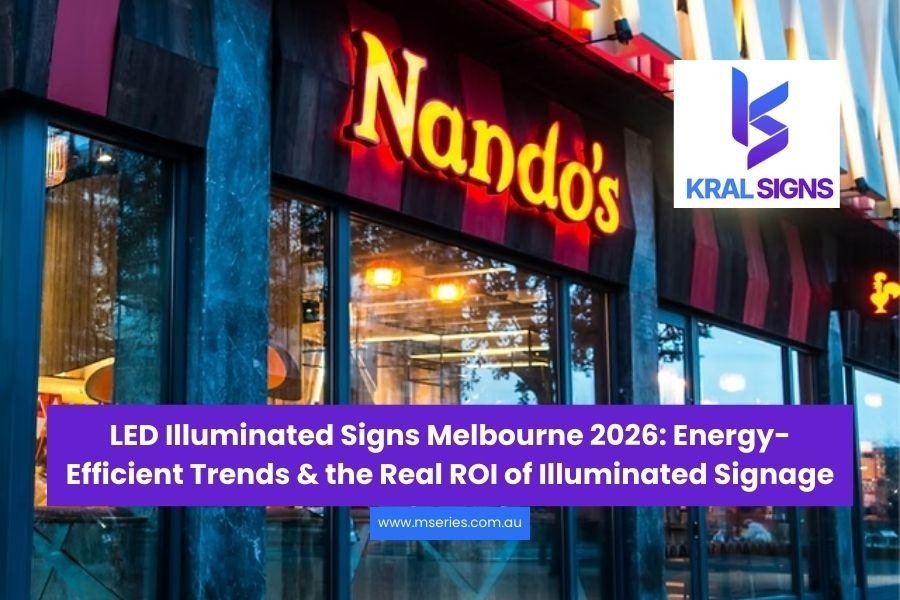
Walk down any busy retail strip in Melbourne at dusk and you'll notice something. The businesses pulling your eye aren't necessarily the biggest or the loudest, they're the ones lit well. A clean, well-designed illuminated sign does something subtle but powerful: it tells a passing customer that someone inside cares about the details. And in 2026, with energy costs high and attention spans short, the pressure is on businesses to invest in signage that works harder for longer.
Illuminated signs Melbourne 2026 are no longer a luxury reserved for major retail chains. From independent cafés in Bayswater to mid-sized hospitality venues across the metro area, businesses of every scale are making the switch to LED-based signage and the reasons go well beyond aesthetics.
This piece looks at where the industry is heading, what the most effective formats are right now, and how to think about the return on investment before you commit to a sign that's going to be on your shopfront for the next decade.
Why LED Has Made Every Other Technology Obsolete
It's worth being direct about this: there is no longer a compelling case for fluorescent or traditional neon signage in a commercial setting. The gap in energy consumption alone is decisive- LED technology uses up to 75% less electricity than older fluorescent tube systems, and the lifespan of a quality LED module runs anywhere from 50,000 to 100,000 hours of use. For a sign running 12 hours a day, that's well over a decade before you're thinking about replacement.
n neon alternatives in Bayswater and across Melbourne have evolved considerably. What's available today isn't a compromise, it's genuinely superior. LED flex neon can be shaped into custom letterforms, logos, and illustrative designs with far greater precision than glass neon ever allowed. The light is consistent, the colours are accurate, and the product doesn't carry the fragility or the gas-related maintenance costs that traditional neon demands.
For businesses that love the warmth and character of neon but are deterred by the running costs and upkeep, modern LED alternatives deliver the same visual impact at a fraction of the lifetime expense. That's not a minor difference: over five years, the savings on electricity and maintenance alone can significantly offset the initial investment.
Energy-Saving LED 3D Letters: The Format Doing the Most Work in 2026
If there's one signage format that has genuinely dominated the conversation in 2026, it's energy-saving LED 3D letters. The appeal is straightforward: they read clearly in daylight, they command attention after dark, they add physical depth and dimension to a façade, and they're doing all of that at a lower energy draw than the signs they're replacing.
The fabrication process has also improved substantially. Letters are now cut from high-grade aluminium or acrylic, faced with polished or brushed finishes, and illuminated from within using tight LED arrays that distribute light evenly without hot spots or bleed. The result is a sign that looks expensive and considered, whether you're viewing it at midday or midnight.
For retail and hospitality businesses, 3D illuminated lettering also has a practical advantage: it reads as a brand marker rather than just a label. Customers who walk past a business with well-executed dimensional signage tend to remember it. That's not a vague impression — it maps directly to foot traffic patterns and return visit rates, particularly in high-competition strips where ten businesses might occupy the same block.
Common applications for LED 3D lettering in 2026 include:
- Shopfront fascia signs for retail, hospitality, and service businesses
- Reception and lobby branding for corporate and commercial spaces
- Feature walls and interior brand installations in restaurants and bars
- Wayfinding and directional signage in shopping centres and public venues
- Healthcare facility identification signage requiring clear, calm visibility
Night Visibility ROI: What the Numbers Actually Tell You
The phrase "return on investment" gets used loosely when people talk about signage. So, it's worth being specific about what night visibility ROI means for retail and hospitality businesses in Melbourne.
A significant proportion of foot traffic for many Melbourne retail strips and hospitality venues falls in the evening window particularly on weekdays when people are moving through commercial areas after work, and on weekends when foot traffic peaks later in the day. A sign that isn't visible after dark isn't working for a substantial portion of its potential audience. It's essentially switched off during some of the most commercially valuable hours of the week.
Businesses that switch from unlit or poorly lit signage to quality LED illumination consistently report an increase in walk-in enquiries from passersby who hadn't previously noticed them. In competitive strips particularly in areas like Bayswater where retail and hospitality operate side by side being the most visible business on the block after 6pm is a genuine commercial advantage.
The ROI calculation for illuminated signs is also helped by the durability of modern LED systems. With a lifespan measured in tens of thousands of hours and minimal maintenance requirements, the cost per impression over the life of the sign is remarkably low. A single well-executed LED sign, installed correctly, can function without significant intervention for ten years or more delivering consistent visibility every night without the ongoing costs that older systems demanded.
The Compliance Side: What Melbourne Businesses Need to Know
One of the less glamorous but genuinely important aspects of signage in Melbourne is council compliance. Different local government areas have different rules around illuminated signage, governing brightness levels, sign dimensions, placement relative to the building line, and in some cases, the hours during which illuminated signage can operate.
Getting this wrong is an expensive mistake. Signs installed without appropriate permits can be required to be removed or modified at the owner's cost, and the fines associated with non-compliant signage can dwarf the original investment. More practically, a sign installed without professional oversight may not meet the structural or electrical safety standards required by Victoria's building and electrical codes.
At Kral Signs, compliance isn't treated as an afterthought, it's built into the process from the initial consultation. The team has deep knowledge of Melbourne Metro council requirements and handles the permit process as part of the full-service offering. When your sign is installed, it's done correctly, documented properly, and backed by professional installation standards that protect both the business and the building.
Industries Seeing the Strongest Results in 2026
While LED illuminated signage delivers value across most commercial contexts, certain industries are seeing particularly strong results this year.
Retail and showrooms are the most obvious beneficiaries. In a shopping environment where the physical and digital retail experience increasingly compete for customer attention, the businesses that invest in striking in-store and exterior signage are differentiating themselves clearly from those that don't. Transparent LED screens in showroom windows, for example, create a dynamic visual layer that draws pedestrian attention in a way that static signage simply cannot match.
Hospitality and entertainment venues have always understood the value of visual impact, but the technology now available allows smaller operators- a neighbourhood bar, a boutique restaurant, a late-night dessert café- to achieve the kind of presence that used to require a much larger budget. Circular LED lightboxes have become a signature feature in Melbourne's hospitality scene, delivering the wow factor without the structural complexity of larger installations.
Healthcare and medical facilities represent a quieter but growing segment. The visual requirements are different, but the durability and reliability of LED systems make them an ideal fit for environments where signage needs to function consistently without maintenance disruption.
Corporate and commercial spaces are also increasingly treating interior LED signage reception branding, directional displays, meeting room identification- as part of their workplace design rather than a functional afterthought. The message it sends to clients and staff alike is one of attention to detail and pride in the environment.
What to Look for When Choosing a Signage Partner
The signage industry in Melbourne has no shortage of providers, and the quality gap between them is significant. A few things genuinely matter when you're planning that's going to affect your business's street presence for the next ten years.
In-house fabrication vs. outsourcing:
A company that designs, manufactures, and installs its own signage has full control over quality at every stage. When something is outsourced, quality assurance becomes fragmented and timelines become unpredictable. At Kral Signs, the entire process is handled in-house, which means one point of contact, consistent standards, and no hidden handoffs.
Visual proofs before production:
You should always see a detailed visual mock-up before anything goes into production. A professionally rendered proof that shows exactly how your sign will look in situ, with accurate colours, proportions, and illumination. This step eliminates the unpleasant surprises that can occur when expectations and reality don't match.
Ongoing support and maintenance:
A sign is not a one-time transaction. Electrical connections need periodic inspection, LED components occasionally require replacement, and as businesses grow or rebrand, signage needs to evolve. Choose a partner who will still be there to support you in year three or year seven - not one who disappears after the installation invoice is paid.
Start the Conversation with Kral Signs
If you're thinking about upgrading your signage in 2026, whether that's replacing ageing neon with modern LED alternatives, adding illuminated 3D lettering to your shopfront, or exploring a full digital display solution.
Kral Signs works with businesses across Melbourne Metro and Victoria, across retail, hospitality, corporate, healthcare, and education sectors. We design, manufacture, and install every sign ourselves- so from your first enquiry to the moment your sign goes live, you're dealing with one team who knows your project inside and out.
Kral Signs works with businesses across Melbourne Metro and Victoria, across retail, hospitality, corporate, healthcare, and education sectors. We design, manufacture, and install every sign ourselves- so from your first enquiry to the moment your sign goes live, you're dealing with one team who knows your project inside and out.
Book a free site assessment, request a quote, or simply browse the full range of products and solutions at www.kralsigns.com.au. Whatever stage you're at, we'll help you figure out the right sign for your space, your brand, and your budget - and we'll make sure it's built to last.
Kral Signs — Designed In-House. Built to Last. Installed to Impress.